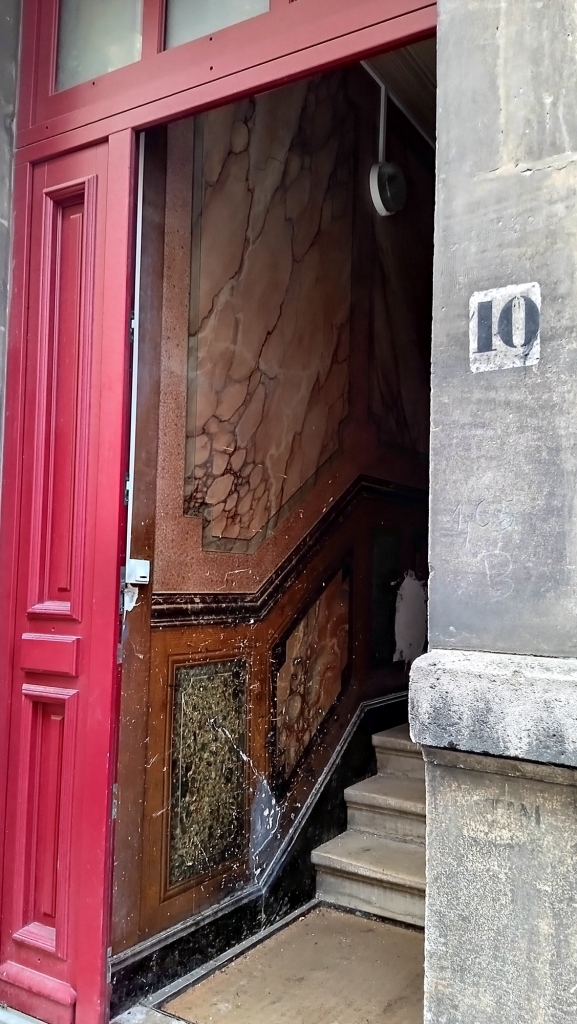
Ok

En poursuivant votre navigation sur ce site, vous acceptez l'utilisation de cookies. Ces derniers assurent le bon fonctionnement de nos services. En savoir plus.

Nancy - Page 2

  • Attention

    FRANÇAIS

    Hier soir, dîner chez Christophe et Emanuele. Je suis passé non pas par la voie rapide habituelle mais par la route de Dieuze que j'avais déjà prise il y a quelques mois pour aller explorer Château-Salins. Elle a l’avantage de ne passer par rien d’autre que des villages et des départementales, en contournant entièrement Nancy, pour la même durée de trajet. Je suis passé par Moyen-Vic, qui m'a plongé dans un état d'extase esthétique incrédule tant son état de délabrement et l'architecture vieillotte de certaines maisons – de vieux immeubles et des maisons de ville mitoyens sur des dizaines de mètres, mais aussi des espèces de chalets en bois sortis des années 70 – me paraissaient une sorte de cauchemar merveilleusement attirant, comme dans certains rêves que j’ai fait ces dernières années.

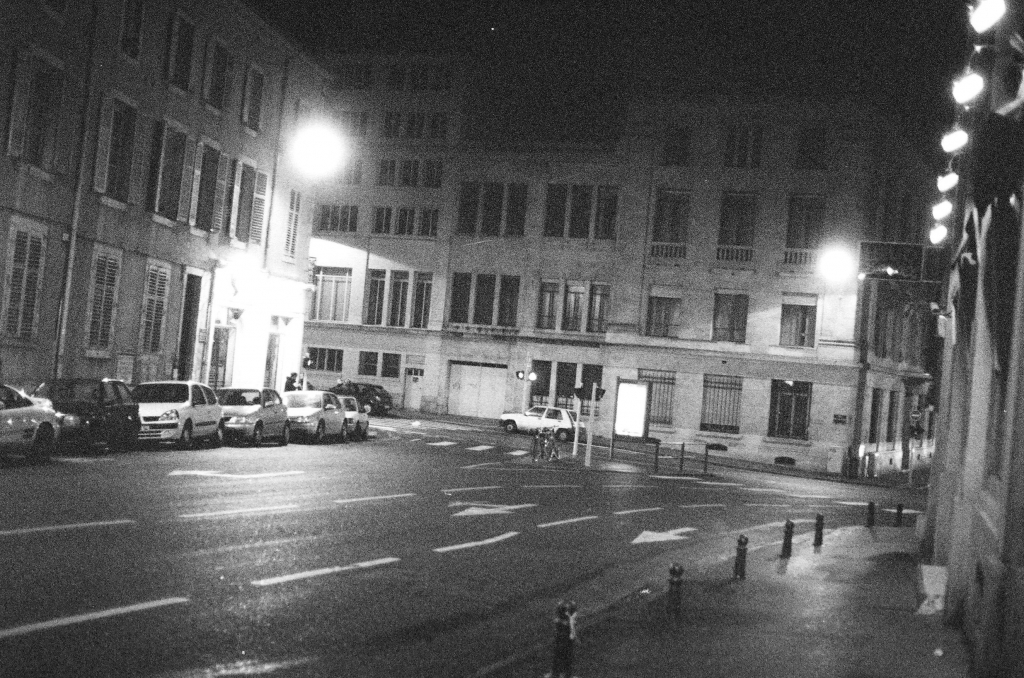
    J'ai eu une expérience similaire dans Nancy, après que nous nous soyons garés dans une rue perpendiculaire à la rue Anatole France – cette rue qui monte vers un bâtiment qui ressemble à un vieil hôpital et où l'on s'était déjà promené en 2022. Il faisait déjà nuit, il n’y avait pas de passants, pas de voiture, tout était agréable et paisible ; les réverbères baignaient la rue de leur lumière artificielle, qui rend tout un peu étrange. C'est une rue ou les immeubles Art Déco, les maisons de ville, les hôtels particuliers et les énormes immeubles HLM brutalistes cohabitent, se jouxtent, sans logique, sans cohérence. Il y avait des vélos garés, des bulles à verre, des fenêtres illuminées à travers lesquelles on pouvait voir des gens dans leur salon ou leur cuisine. C’était incroyablement réel. Un moment de vie réelle, un morceau du monde réel. Je me suis dit « Je suis à Nancy » comme si ce n’était pas une évidence ou quelque chose de banal. Comme on se le dirait dans un rêve, avec une légère incrédulité, avec cette sensation où se mêlent un sentiment d'hyperréalité et de totale étrangeté à la fois ; avec ce mélange d’attention décuplée et d’impression de rêver.

    Parce que c’est ça la question majeure : l’attention. Dans les rêves l'attention est beaucoup plus grande, paradoxalement, qu'à l'état de veille ; nous dormons en réalité à l'état de veille, nous fonctionnons en pilotage automatique, inattentifs à ce qui nous entoure et que nous avons déjà vu mille fois : telle rue, tel objet. Et nous vivons réellement dans notre sommeil, là où tout paraît neuf et étonnant, beau ou laid, réconfortant ou effrayant, ou simplement présent et bien réel, face à nous.

    ENGLISH

    Last night, dinner at Christophe and Emanuele’s. I didn’t take the usual expressway but instead went by the Dieuze road, the one I’d already taken a few months ago to explore Château-Salins. It has the advantage of passing through nothing but villages and small departmental roads, completely bypassing Nancy, yet taking just as long. I went through Moyen-Vic, which sent me into a kind of incredulous aesthetic rapture, so dilapidated were some of its old houses and apartment buildings – long rows of adjoining townhouses, but also these strange wooden chalets straight out of the 1970s – all of it forming a sort of wonderfully enticing nightmare, like in certain dreams I’ve had in recent years.

    I had a similar experience in Nancy, after we parked the car in a street perpendicular to Rue Anatole France – that street that climbs toward a building resembling an old hospital, where we had already walked in 2022. It was already dark; there were no passersby, no cars, everything was calm and pleasant. The streetlights bathed everything in their artificial glow, making it all slightly unreal. It’s a street where Art Deco buildings, townhouses, private mansions, and massive brutalist housing blocks coexist, side by side, with no logic, no coherence. There were bicycles parked, recycling bins, and illuminated windows through which one could see people in their living rooms or kitchens. It was incredibly real – a moment of real life, a fragment of the real world. I said to myself, "I’m in Nancy", as though it weren’t obvious or banal – as though one might say it in a dream, with a touch of disbelief, with that feeling where hyperreality and utter strangeness mingle; that mix of heightened attention and the sensation of dreaming.

    Because that’s really the central question: attention. In dreams, attention is paradoxically much sharper than in waking life; in truth, it’s when awake that we sleep – moving through the world on autopilot, inattentive to what surrounds us, to what we’ve already seen a thousand times: a certain street, a certain object. And we truly live in our sleep, where everything seems new and astonishing, beautiful or ugly, comforting or frightening, or simply present, vividly real, right before us.

    Lien permanent Catégories : Blog, Explorations, Nancy 0 commentaire Pin it!
  • Silhouettes indistinctes / Indistinct figures (2006)

    FRANÇAIS

    Elle vivait dans un immeuble étroit, avenue de la Libération, qui jouxtait un squat et des maisons bourgeoises terrées au fond de parcs impénétrables. Une zone floue, accablée de voitures jour et nuit. La cage d'escalier était déserte à toute heure. Ses portes auraient tout aussi bien pu n'ouvrir que sur des logements déserts, des tombeaux. Des photos d'elle, nue, en noir et blanc, décoraient le couloir d'entrée. Je me souviens de sa chambre plongée dans le noir, et de l'immense miroir qui couvrait toute la penderie, auquel nous faisions face et où nous regardions nos silhouettes indistinctes faire l'amour sur le lit. Une petite radio diffusait du Chopin en sourdine, dans la salle de bain vieillotte et mal éclairée, avec son carrelage douteux et sa baignoire d'un autre siècle. Il y planait une odeur d'humidité et de vieux murs, mélangée à celle de l'encens et des bougies. C'était l'odeur de Nancy, une odeur de vieillesse immémoriale de solitude, d'inconfort, c'était celle de ma jeunesse, et je l'aimais.

    ENGLISH

    She lived in a narrow apartment building on Avenue de la Libération, nestled between a squat and bourgeois houses hidden deep within impenetrable gardens. A blurry zone, choked with cars day and night. The stairwell was deserted at all hours. Its doors might as well have opened onto empty apartments or tombs. Black-and-white nude photos of her adorned the entrance hallway. I remember her room plunged in darkness, and the huge mirror that covered the wardrobe, which we faced, watching our indistinct silhouettes making love on the bed. A small radio played Chopin softly in the background, in the old, dimly lit bathroom, with its dubious tiles and a bathtub from another century. There was a scent of damp and old walls hanging in the air, mixed with incense and candle wax. It was the smell of Nancy – a scent of ancient age, solitude, discomfort – it was the scent of my youth, and I loved it.

    Lien permanent Catégories : Nancy, Souvenirs / Memories 0 commentaire Pin it!
  • Spotlights

    goth (1).jpg

    goth (2).jpg

    goth (3).jpg

    FRANÇAIS

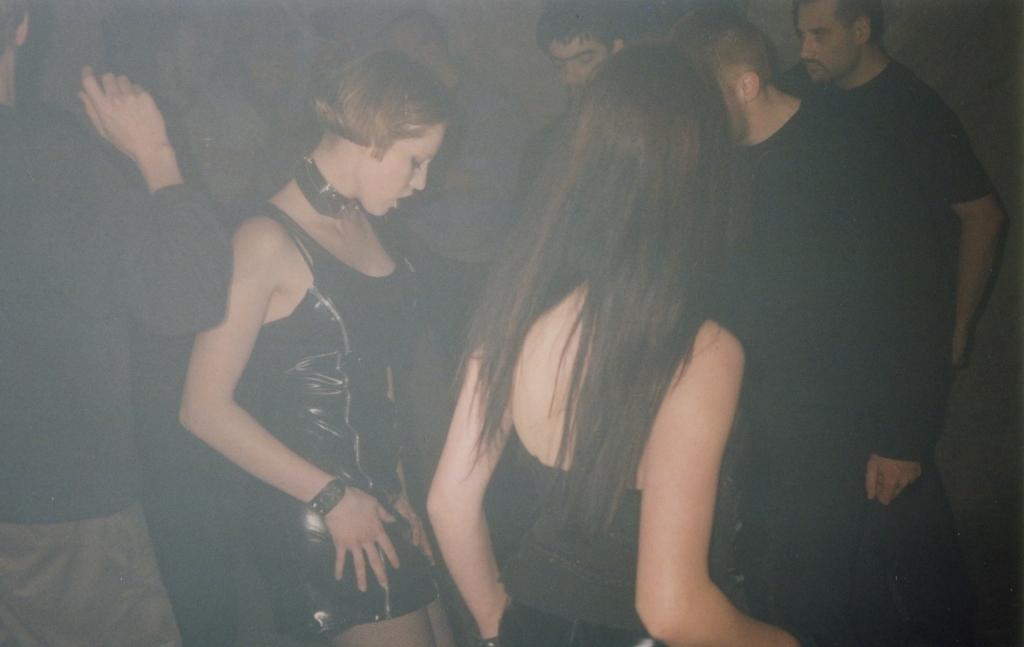
    L'odeur d'humidité et de cave, mêlée à celle de la machine à fumer ; l'odeur magique, disparue, des cigarettes, mêlée à celle de la bière qui flotte dans l'air ; la chaleur des corps et des spotlights ; Joy Division, The Cure, Dead Can Dance, Cocteau Twins, à un volume assourdissant.

    ENGLISH

    The smell of dampness and cellar, mixed with that of the smoke machine; the magical, vanished scent of cigarettes, mingled with the beer floating in the air; the warmth of bodies and spotlights; Joy Division, The Cure, Dead Can Dance, Cocteau Twins, at a deafening volume.

    Lien permanent Catégories : Nancy, Photos, Souvenirs / Memories 0 commentaire Pin it!
  • Rentrée 1999

    Neg_2000-2002_(3)_102.jpg

    FRANÇAIS

    Je scanne pour la première fois les négatifs de ma jeunesse, ces jours-ci, et non seulement je découvre des photos que je n'avais jamais fait développer mais je redécouvre, et c'est presque tout aussi frappant, des photos que jusqu'ici je ne voyais plus que via des scans d'assez mauvaise qualité faits au début des années 2000 et dont je m'étais contenté jusque là.

    Le passage du temps équivaut normalement à la perte d'information, que ce soit en perte de qualité, ou par la perte, au sens propre, du document lui-même. Ici, curieusement, j'ai à quarante-cinq ans le privilège de voir pour la première fois des traces en haute définition de mon propre passé – de la même manière qu'après toute une vie de visionnages à la télé, sur VHS ou sur des DVD mal encodés, je découvre aujourd'hui certains vieux films qui ont compté pour moi avec une image absolument parfaite, comme s'ils venaient de sortir au cinéma.

    Et que dire des archives filmiques du début du XXè siècle auxquels l'IA donne une nouvelle propreté, une fluidité de mouvement qui ressuscite tout ce qu'elles montrent ? 

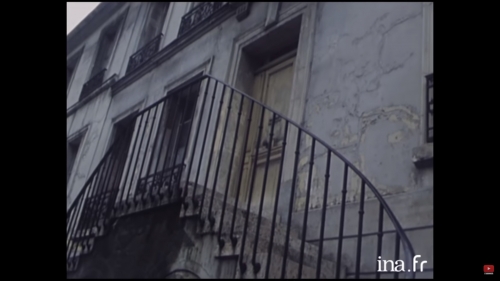
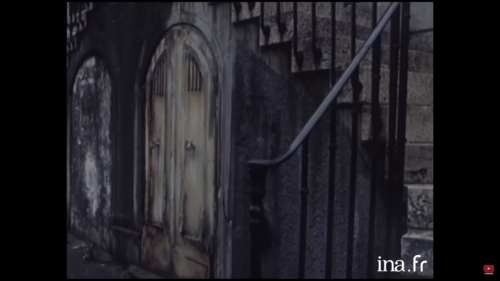
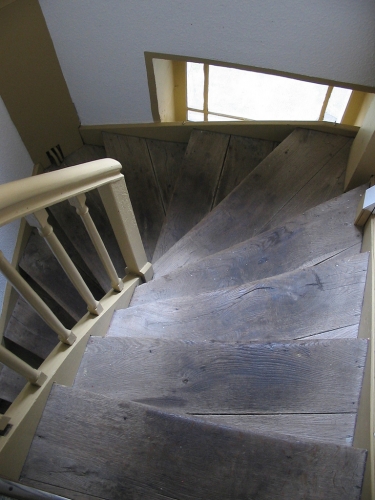
    Cette rentrée 99 avait commencé très studieusement par un après-midi à fumer des joints dans cet immeuble délabré de la rue du Placieux, où il ne fallait pas s'appuyer à la rambarde, dans l'escalier, car elle était sur le point de se détacher ; j'en avais le vertige et j'en ai rêvé un certain nombre de fois, sous diverses formes.

    1) Avec David et sa copine, et plein de goths devant un immeuble banal. On attend le début d'une soirée. Les portes finissent par s'ouvrir et tout le gens s'en vont, d'un coup. Je les sens partir plus que je ne les vois : j'ai les yeux rivés sur la cage d'escalier de l'immeuble, qui tangue comme s'il y avait un tremblement de terre.

    2)  Je dois aller dans un appartement HLM avec un orchestre classique pour animer une soirée chez un particulier. J'ai du mal à trouver l'appartement, les numéros ne correspondent pas, les HLM sont d'horribles cages d'escaliers sales au-delà des mots, vieilles, taguées, pas éclairées... Nous finissons par nous retrouver dans un appartement mais je réalise que ce n'est pas le bon. Il n'y a personne dedans. Pendant que l'orchestre joue, je ressors à la recherche du bon numéro. C'est encore pire qu'avant, il y a des parties en ruines où l'on ne peut plus monter, des bouts de rambarde manquants, et toujours personne.

    3) Je descends un escalier, probablement à la fac ou dans un endroit du genre. La cage d'escalier en elle-même est immense, et les escaliers, qui longent les quatre murs, sont étroits. Les murs sont nus. Aucun décor ni portes, on est comme dans un silo rectangulaire. À un moment donné, en plein milieu d'un « étage », les marches s'arrêtent, donnant sur le vide. Cette seule vision me donne le vertige et m'emplit d'une angoisse autant morale que physique. Avec difficulté, au ralenti, je rebrousse chemin, pour constater que derrière moi, l'escalier a changé ; il est encore plus étroit et semble effondré, voire fondu, formant par moment une simple plateforme de métal et de pierre mêlées, sur lequel je dois ramper pour remonter.

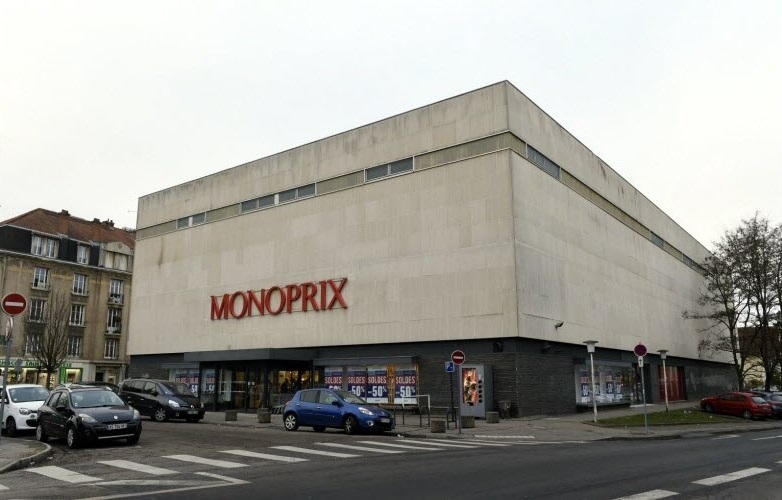
    J'avais sympathisé avec Laetitia je ne sais plus comment, par un autre après-midi à errer en suivant plus ou moins passivement d'autres étudiants affairés à quelque chose (des courses ? un travail pour la fac ?) dans le quartier où elle vivait, aux abords du Monoprix de Villers-lès-Nancy, ce cube de béton, soviétoïde, posé là comme un vaisseau extraterrestre ou une Kaaba dédiée au dieu de la consommation. Tout le quartier était gris, bétonné, adorable.

    mono.jpg

    Elle vivait dans un chaos indescriptible, le contenu de ses armoires et de ses tiroirs presque constamment vidé au sol ou sur le lit, comme si après un cambriolage elle avait décidé d'en rester là.

    ENGLISH

    These days, I’m scanning the negatives from my youth for the first time. Not only am I discovering photos I never had developed, but I’m also rediscovering – almost just as strikingly – photos I had only seen through low-quality scans made in the early 2000s, which I had been content with until now.

    Normally, the passage of time means the loss of information – whether in terms of image quality or through the actual loss of the document itself. But here, curiously, at forty-five years old, I have the privilege of seeing high-definition traces of my own past for the first time – just like when, after a lifetime of watching movies on TV, on VHS, or poorly encoded DVDs, I now discover some of the old films that mattered to me with a flawless image, as if they had just premiered in cinemas.

    And what can be said about early 20th-century film archives, now given new clarity and fluid motion by AI – resurrecting everything they depict?

    That fall of ’99 began very studiously with an afternoon spent smoking joints in that dilapidated building on rue du Placieux, where you couldn’t lean on the stair railing – it was about to come loose. I felt dizzy just looking at it, and I’ve dreamed of that staircase many times since, in various forms:

    1) With David and his girlfriend, and a bunch of goths standing in front of an ordinary apartment building. We're waiting for a party to start. Eventually, the doors open and everyone suddenly leaves. I feel their departure more than I see it: my eyes are fixed on the building’s staircase, which sways as if in an earthquake.

    2) I’m supposed to go to a housing project apartment with a classical orchestra to play at someone’s private party. I struggle to find the right apartment – none of the numbers match. The buildings are horrid: stairwells beyond filthy, ancient, graffitied, dark... We end up in one apartment, but I realize it’s the wrong one. No one’s inside. While the orchestra plays, I head back out in search of the right place. It’s even worse than before – some areas are in ruins, inaccessible, sections of railing missing, and still no one around.

    3) I’m descending a staircase – probably at the university or somewhere similar. The stairwell itself is enormous, with narrow stairs running along the four walls. The walls are bare. No decoration, no doors – we’re inside something like a rectangular silo. At some point, halfway through a « floor » the stairs just stop, giving way to empty space. The sight alone fills me with vertigo and a dread that’s both moral and physical. Slowly, with difficulty, I try to go back, only to find the stairs behind me have changed: they’re even narrower and seem to have collapsed – or melted – forming, at times, just a platform of mixed stone and metal I have to crawl across to get back up.

    I became friends with Laetitia – I no longer remember how – during another afternoon spent wandering, more or less passively following some other students who were busy with something (shopping? a university project?) in the neighborhood where she lived, near the Monoprix in Villers-lès-Nancy: that brutalist concrete cube, Soviet-esque, dropped there like an alien spaceship or a Kaaba devoted to the god of consumerism. The whole neighborhood was grey, full of concrete – and utterly charming.

    mono.jpg

    She lived in indescribable chaos: the contents of her drawers and cupboards were almost always strewn across the floor or the bed, as if, after a burglary, she’d simply decided to leave things that way.

    Lien permanent Catégories : Blog, Nancy, Photos, Souvenirs / Memories 0 commentaire Pin it!
  • Appartement secret / Secret appartment

    FRANÇAIS

    Une fête foraine, un soir d'été. Je m'y balade, accompagné, avec mon appareil photo. Ensuite, je suis avec ma collègue Éliane, à qui je dis que j'ai un appartement secondaire et secret, dans un village à la campagne, quelque part en Lorraine – peut-être sur la route entre Nancy et Blâmont. Sensation de nuit, de protection, de sérénité, lié à cet appartement secret où je peux me cacher et me ressourcer si j'ai besoin de m'y rendre, en pleine nuit.

    ENGLISH

    A funfair on a summer evening. I'm walking around with my camera, accompanied by someone. Then I'm with my colleague, to whom I say that I have a secret second home in a village in the countryside, somewhere in Lorraine – perhaps on the road between Nancy and Blâmont. A feeling of night, of protection, of serenity, linked to this secret home where I can hide and recharge my batteries if I need to go there in the middle of the night.

    Lien permanent Catégories : Blâmont, Nancy, Récits de rêve / Dreams 0 commentaire Pin it!
  • Nathalie

    FRANÇAIS

    C'est ma première soirée seul à Nancy. J'ai dix-huit ans. Il fait une chaleur insoutenable, et depuis la veille j'évolue dans une hébétude alcoolique entrecoupée de retraites, torse nu, dans la cage d'escalier de mon immeuble où l'obscurité et le silence sont complets. Je marche au hasard dans la ville. J'ai vaguement conscience de descendre vers le grand parc de la Pépinière, découvert la veille. Une femme en robe noire, au regard vide, me croise, au carrefour d'une rue dont je retiens le nom : Damerval. Je l'entends s'effondrer, derrière moi, à quelques mètres. Je l'aide à se relever et fais signe à un type qui approche, que je vais m'en occuper. Elle est complètement confuse, me tutoyant d'emblée. Elle me dit qu'elle habite rue de la Source et je décide de la ramener chez elle, même si je n'ai aucune idée d'où cela se trouve. Elle m'attire énormément et je me fais des films mentaux pendant qu'elle divague. Elle finit par me parler de sa dépendance au Subutex, de son fils mort, de son père qui s'est tiré une balle dans la bouche. Elle s'appelle Nathalie. Elle me dit qu'elle vit avec un certain Hassan ou Hassen, qu'elle décrit comme obèse et ayant « le coeur sur la main ». Arrivés chez elle, elle trouve porte close et agonit d'injures le Hassan ou Hassen en question, manifestement absent, puis nous redescendons. Elle me dit qu'elle comptait travailler ce soir et je finis par comprendre.

    Quand nous ressortons Hassan ou Hassen arrive, obèse au-delà de toute mesure, des bagues aux doigts, un mauvais sourire. La fille essaie de marcher toute seule, trébuche. Elle finit assise à même le sol, dos au mur, dans la ruelle, les cuisses écartées, défaite. Sa culotte noire, transparente, ne cache rien. Je vais pour l'aider à se relever mais Hassan ou Hassen me dit « Laisse. Il va falloir qu'elle se lève toute seule, il faudra bien qu'elle y arrive », sur un ton serein, dénué de toute compassion comme de toute méchanceté, et avec, à mon égard, une curieuse complicité, ou quelque chose qui relève d'une initiation. Elle parvient à se relever au bout d'un petit moment puis ils rentrent chez eux. Elle me dit, avant de nous quitter, que c'est bon pour le plan à trois, qu'untel est au courant, et je ne sais pas si dans son état elle me confond avec un autre, ou si elle joue la comédie devant son lui pour une raison quelconque. Mais elle m'embrasse sur la bouche avant de disparaître. Pendant des années qui suivent, je reviens sans arrêt dans cette rue. Et jamais je ne la revois, ni rue de la Source, ni ailleurs.

    Je ne me souviens plus de son visage. Elle est devenue un fantôme comme tant d'autres. J'ai souvent croisé, rue de la Source, une prostituée âgée, perpétuellement debout, parfois assise sur une chaise de bois. Elle se tenait à l'angle avec la rue Saint-Michel, et quasiment devant l'immeuble où Nathalie m'avait fait entrer – au numéro 20, probablement. J'aurais pu l'interroger ; je ne l'ai jamais fait.

    ENGLISH

    It's my first evening alone in Nancy. I'm eighteen. The heat is unbearable, and since the day before I’ve been drifting in an alcoholic stupor, broken up by shirtless retreats into the stairwell of my building, where darkness and silence are absolute. I wander through the city without direction. I’m vaguely aware I’m heading toward the big park, the Pépinière park, which I discovered the day before. A woman in a black dress, with a vacant look in her eyes, crosses my path at the corner of a street whose name I remember: Damerval. I hear her collapse behind me, just a few meters away. I help her up and wave off a man who’s approaching, signaling that I’ll take care of it. She’s completely disoriented, addressing me informally right away. She says she lives on Rue de la Source, and I decide to walk her home, though I have no idea where that is. I’m incredibly drawn to her and start playing out mental fantasies while she rambles. Eventually she tells me about her Subutex addiction, her dead son, her father who shot himself in the mouth. Her name is Nathalie. She says she lives with someone named Hassan or Hassen, whom she describes as obese and "with a heart of gold". When we arrive, the door is locked. She curses out the absent Hassan or Hassen, then we go back down. She tells me she was supposed to be working tonight, and I finally understand.

    As we step outside again, Hassan or Hassen shows up – grotesquely obese, rings on every finger, wearing a sly, unpleasant smile. The woman tries to walk on her own but stumbles. She ends up sitting on the ground, back against the wall, legs spread, undone. Her black, transparent underwear hides nothing. I go to help her up, but Hassan or Hassen stops me: "Leave her. She’s going to have to get up on her own, sooner or later", he says calmly, without either cruelty or compassion, and with, toward me, a strange sort of complicity – or something that felt like an initiation. She manages to get up after a while, and they go inside. Before leaving, she tells me the threesome is on, that someone’s been informed, and I can't tell if in her state she’s mistaking me for someone else, or if she’s putting on an act for him for some reason. But she kisses me on the mouth before vanishing. For years afterward, I keep returning to that street. I never see her again – not on Rue de la Source, not anywhere.

    I no longer remember her face. She’s become a ghost, like so many others. I often came across an older prostitute on Rue de la Source, always standing, sometimes sitting on a wooden chair. She stood on the corner with Rue Saint-Michel, almost in front of the building where Nathalie had taken me in – number 20, probably. I could have asked her about Nathalie. I never did.

    Lien permanent Catégories : Nancy, Souvenirs / Memories 0 commentaire Pin it!
  • Matin gris / Grey morning

    FRANÇAIS

    Je marche dans ce qui semble être une grande ville, sur une chaussée qui borde un immense espace ouvert (cerné de rues où circulent les voitures) faisant penser au cours Léopold à Nancy, en bien plus grand. Je ne crois pas être accompagné mais je marche à côté d'un groupe d'autres personnes. Le temps est sombre, gris, pluvieux, mais d'une façon agréable, réconfortante comme un temps de rentrée des classes. Le sol est trempé et j'avance en glissant sur l'eau, comme si je faisais du ski. Je parle à quelqu'un, peut-être mentalement, de bâtiments ou de choses que je veux voir à quelques dizaines de mètres, sur le même vaste plan que nous sommes en train de  traverser. Je sais que je suis déjà venu ici mais sans vraiment prendre mon temps. À un croisement, je passe au passage piéton mais m'arrête au milieu pour une raison que j'ai oubliée. Je me retourne et vois derrière moi un élément de décor que je n'avais pas remarqué – je ne sais plus quoi. Je le prends en photo, plusieurs fois, découpé sur les immeubles bourgeois et le ciel pluvieux, sombre, à la fois menaçant et réconfortant.

    récits de rêves,rêves,rêve

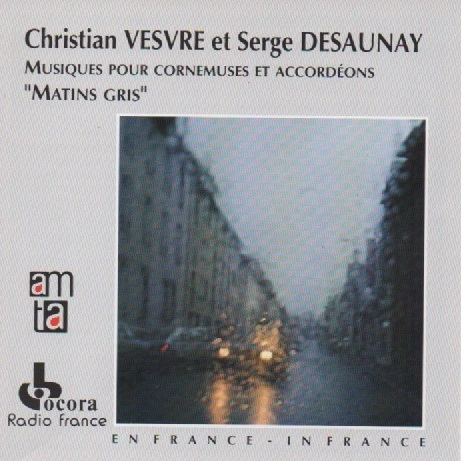
    Mon esprit semble avoir fait un amalgame entre la pochette de ce disque que j'ai écouté ces jours-ci et le cours Léopold et ses abords – Dieu sait pourquoi.

    ENGLISH

    I'm walking through what seems to be a large city, along a pavement bordering a vast open space (surrounded by streets where cars pass), reminiscent of the Cours Léopold in Nancy – only much larger. I don't think I'm accompanied, but I'm walking alongside a group of other people. The weather is dark, grey, rainy, but in a pleasant, comforting way – like the weather at the start of a new school year. The ground is soaked, and I glide forward over the water, as if skiing. I'm talking to someone – maybe only in my head – about buildings or places I want to see a few dozen meters away, on the same vast plane we're now crossing. I know I've been here before, but never really took the time. At an intersection, I cross at the pedestrian light but stop halfway through for a reason I've forgotten. I turn around and see behind me something in the scenery I hadn't noticed before – I no longer know what it was. I take a photo of it, several times, silhouetted against the bourgeois buildings and the rainy, dark sky – both threatening and strangely comforting.

    récits de rêves,rêves,rêve

    My mind seems to have conflated the cover of this record I’ve been listening to lately with the Cours Léopold and its surroundings – God knows why.

    Lien permanent Catégories : Nancy, Récits de rêve / Dreams 0 commentaire Pin it!
  • Campus (2015)

    FRANÇAIS

    J’erre dans les couloirs de la fac de lettres, exceptionnellement vides, repeints de frais, comme un cadeau que me ferait le destin ; me laisser déambuler ici, enfin seul, comme dans un rêve ou dans mes souvenirs matérialisés – car tous mes souvenirs ou presque sont des souvenirs solitaires.

    Des rideaux opaques, grisâtres, comme teintés par des siècles de poussière et de pénombre, cachent l'intérieur de certains bureaux, comme des maisonnettes au milieu des couloirs. Des mondes imbriqués, cachés. Certains sont manifestement occupés ; on devine des lampes allumées à travers le tissu. Aucun bruit ne s'en échappe. Qui est là ?

    Un peu plus loin, des portes en verre armé laissent filtrer des lumières rouges, ou bleues, intense et étranges, comme si l’on avait installé dans les salles qu’elles cachent des projecteurs de couleurs. Et la lueur verdâtre qui s’échappe des toilettes publiques. Entre tout cela, des poches d’ombres, des couloirs déserts aux ombres interminables. On a l'impression d'avancer dans un espace qui pour toujours existe dans un temps qui n'est ni le jour, ni la nuit.

    L'architecture brutaliste, uniformément grise des bâtiments, lorsqu'on les entrevoit par une fenêtre, ne laisse rien deviner du monde chaud, intime, d'ombres et de poches de couleurs qu'ils recèlent.

    ENGLISH

    I wander through the halls of the humanities building, exceptionally empty, freshly repainted, like a gift from fate; letting me roam here, finally alone, as if in a dream or in my memories made tangible – for all my memories, or almost all, are solitary ones.

    Opaque, grayish curtains, as if stained by centuries of dust and gloom, hide the interiors of certain offices, like little houses nestled within the corridors. Interlocking, hidden worlds. Some are clearly occupied; you can make out the glow of lamps behind the fabric. No sound escapes. Who’s in there?

    A bit further on, doors of reinforced glass let through red or blue light, intense and strange, as if colored spotlights had been installed in the rooms beyond. And the greenish glow leaking from the public restrooms. Between all this, pockets of shadow, deserted corridors with endless silhouettes. It feels like moving through a space that forever exists in a time that is neither day nor night.

    The brutalist architecture, uniformly gray, glimpsed through a window, gives no hint of the warm, intimate world inside—a world of shadows and pockets of color it secretly holds.

    Lien permanent Catégories : Nancy, Souvenirs / Memories 0 commentaire Pin it!
  • Un monde de ruelles / A world of backstreets (2011)

    exploration psychogéographique,être perdu,hébétude,larmes,hortensias

    exploration psychogéographique,être perdu,hébétude,larmes,hortensias

    FRANÇAIS

    Des après-midi entières j'avance hébété dans les rues de quartiers qui me sont inconnus. Le sentiment d'être perdu, de me perdre volontairement, mêlé au choc de la vision de certains immeubles, de certaines ruelles, de certains détails comme des volets rouillés ou des hortensias morts dans un jardinet, me mènent au bord des larmes. Je parle seul avec la conscience que les passants, les automobilistes me voient, mais je crois en leur réalité encore moins qu'en la mienne.

    Je m'enfonce de plus en plus dans un monde toujours plus éloigné du centre et des lieux de vie, un monde de ruelles et d'arrière-cours, d'entrées d'immeuble sordides, de fenêtres opacifiées, de rideaux vieillots et sales, de rouille et d'odeurs de cave, où je peux enfin trouver le repos.

    ENGLISH

    Entire afternoons I wander dazed through the streets of neighborhoods unknown to me. The feeling of being lost – of deliberately losing myself – mixed with the shock of seeing certain buildings, certain alleyways, certain details like rusted shutters or dead hydrangeas in a tiny garden, brings me to the verge of tears. I talk to myself, fully aware that passersby and drivers can see me, but I believe in their reality even less than in my own.

    I sink deeper and deeper into a world ever more removed from the center and from places where life happens  – a world of alleyways and backyards, of sordid building entrances, of clouded windows, faded and dirty curtains, rust and the smell of damp cellars, where I can finally find rest.

    Lien permanent Catégories : Explorations, Nancy, Souvenirs / Memories 0 commentaire Pin it!
  • La fatigue et la vieillesse (non-daté) / Old age and fatigue (undated)

    FRANÇAIS

    J'entre dans des cours intérieures, des résidences muettes et qui semblent inhabitées. L'humidité et la moisissure mangent le crépi gris, contaminent tout de leur noirceur puante, qui vide le cœur de tout courage. Combien d'étudiants, de jeunes hommes et de jeunes femmes, dans ces murs qui étaient vieux avant même d'avoir été achevés ? Je les imagine au début de leur vie adulte, avec quelque chose sur le visage qui trahit déjà la fatigue et la vieillesse, une  fatigue qui émane des murs et les irradie jusqu'au plus profond de leurs cellules. Eux aussi, vieux avant d'avoir été construits.

    ENGLISH

    I enter inner courtyards, silent residences that seem uninhabited. Dampness and mold eat away at the gray plaster, contaminating everything with their foul blackness, which empties the heart of all courage. How many students, young men and women, within these walls, that were old even before they were finished? I picture them at the beginning of their adult lives, with something on their faces already betraying fatigue and old age, a fatigue that emanates from the walls and irradiates them down to the deepest part of their cells. They too, old before they were built.

    Lien permanent Catégories : Explorations, Nancy, Souvenirs / Memories 0 commentaire Pin it!
  • Attentat / Attack

    FRANÇAIS

    Je suis dans une galerie commerciale type centre Saint-Sébastien, en plus obscur, plus « renfermé », vieillot et qui dégage une impression de saleté, de vétusté. Je passe en revue plusieurs boutiques, je ne sais plus de quoi – peut-être d'informatique ou de téléphonie. J'entre dans un kebab, pas pour consommer, mais pour une autre raison ; attendre quelqu'un ou peut-être accéder à une autre partie du centre commercial, car il est labyrinthique et la notion d'intérieur et d'extérieur y est très floue. J'assiste à une scène dans une arrière-boutique, avec le ou les patrons, et peut-être une femme ; la préparation d'un attentat ? Des objets louches stockés là-dedans ? Je décide de m'éclipser, et ressors par une porte qui mène à la cage d'escalier (très 70's, en marbre et rambardes de bois) d'un immeuble d'habitation. Je descends au rez-de-chaussée où se trouvent de très larges portes vitrées, qui font toute la façade. Je suis enfermé à l'intérieur.

    *

    J'ai toujours aimé les galeries commerciales, qu'elles soient sur le modèle des grands magasins parisiens, où tous les articles sont présentés ensemble, au sein d'un seul immense espace – ou bien selon le modèle plus récent de la division en cellules, qui chacune contient une enseigne précise.

    J'aime le Karstadt à Sarrebrück.

    J'aime le centre Saint-Sébastien à Nancy.

    J'y ai d'innombrables souvenirs d'enfance ou de mes années d'étudiant. J'aime les lieux artificiels de manière générale, comme les zoos ou les parcs d'attraction : ce n'est pas le monde réel mais une version miniature, sécurisée et faite pour le plaisir. Les centres commerciaux me font le même effet, et ils ont un charme spécifique qui est qu'on y est à l'intérieur ; pas de ciel, pas de soleil ni de lune, pas d'oiseaux, pas de grand air, on est, comme dans le métro, dans un espace 100 % humain. Une sorte de rêve, d'espace d'autonomie totale, de séparation totale avec le monde réel. Un espace entièrement social et symbolique. J'aime aussi ces lieux non pas en dépit du fait qu'ils vieillissent mal mais à cause de lui ; la saleté, la moisissure, la pollution, prennent rapidement le pas sur les surfaces propres et neuves. J'ai toujours aimé la crasse de la ville. C'est pour ça que j'ai toujours aimé Nancy. Même si cette attirance n'est pas exempte d'angoisse. La pollution, la grisaille, la crasse, le béton, les labyrinthes de couloirs et d'escaliers sont répugnants et attirants comme la mort.

    Dans mes rêves plus récents, le décor change un peu ; ce n'est pas un Saint-Sébastien obscur mais des centres commerciaux qui ressemblent désormais à ceux de mon enfance, en terme de décoration, d'ameublement, de matériaux typiques des années 70. Au fur et à mesure que je vieillis, mes rêves creusent plus profond.

    ENGLISH

    I'm in a shopping arcade – something like the Saint-Sébastien mall, but darker, more "shut-in", old-fashioned, and steeped in a sense of dirtiness and decay. I walk past several shops – I can’t remember what kind, maybe electronics or phone stores. I enter a kebab place, not to eat, but for some other reason; maybe to wait for someone, or to access another part of the shopping center. The layout is labyrinthine, and the boundary between indoors and outdoors is extremely blurred. In a back room, I witness a scene involving the owner – or owners – and perhaps a woman; the preparation of an attack? Some shady goods being stored there? I decide to slip away quietly and exit through a door that leads into a stairwell – very 1970s, with marble and wooden railings – inside a residential building. I go down to the ground floor, where there are large glass doors making up the entire façade. I’m locked inside.

    *

    I’ve always loved shopping arcades–whether they follow the model of Parisian department stores, with all items displayed together in one massive space, or the more recent design divided into individual units, each housing a specific brand.

    I love the Karstadt in Saarbrücken.

    I love the Saint-Sébastien mall in Nancy.

    I have countless memories there from childhood and my student years. I’ve always loved artificial places in general, like zoos or amusement parks: they’re not the real world, but a miniature, safer, pleasure-oriented version of it. Shopping malls have the same effect on me, with a special charm: you're indoors–no sky, no sun or moon, no birds, no fresh air. Like in the subway, you're in a 100% human-made space. A kind of dream, a space of total autonomy, total separation from the real world. A space that is entirely social and symbolic. And I don’t love these places in spite of the fact that they age poorly – I love them because of it. Dirt, mold, pollution quickly overtake clean, new surfaces. I’ve always liked urban grime. That’s why I’ve always liked Nancy. Even though this attraction comes with a touch of anxiety. Pollution, drabness, filth, concrete, the labyrinths of hallways and stairwells–they’re revolting and alluring, like death.

    In my more recent dreams, the scenery shifts slightly: it’s no longer a dark Saint-Sébastien but shopping centers that now resemble those of my childhood, in terms of decor, furnishings, and the materials typical of the 1970s. As I grow older, my dreams dig deeper.

    Lien permanent Catégories : Nancy, Récits de rêve / Dreams 0 commentaire Pin it!
  • Avec Céline / With Céline (1995)

    FRANÇAIS

    Je raccompagne Céline chez elle, rue de Mon-Désert. Les rues baignent dans une lumière orange étrange,  excessivement colorée, mais malgré le fait que ce soit une couleur chaude, le tout a un côté malaisant, bizarre dans le sens déplaisant du terme. Des voitures sont stationnées absolument partout, une véritable invasion automobile. Là aussi cela a quelque chose d'étrange et d'excessif, renforcé par le fait qu'on ne croise absolument personne, et qu'il n'y a aucun bruit. D'autres rues du quartier sont plongées dans une obscurité complète. 

    ENGLISH

    I'm walking Céline home, to her place on Rue de Mon-Désert. The streets are bathed in a strange orange light – excessively saturated. And even though it's a warm color, the whole scene feels unsettling, disturbing in an unpleasant way. Cars are parked absolutely everywhere, a true invasion of automobiles. That too feels strange and over the top, made even more surreal by the complete absence of people and the total silence. Other streets in the neighborhood are plunged into complete darkness.

    Lien permanent Catégories : Nancy, Souvenirs / Memories 0 commentaire Pin it!
  • À l'aveuglette / Blindly

    FRANÇAIS

    Je marche dans des rues entièrement noires où j'avance presque à l'aveuglette, me repérant grâce aux rares enseignes lumineuses, qui elles-mêmes n'offrent qu'une lueur faiblarde, insuffisante. Je suis probablement à Nancy. Je vais quelque part, je ne sais plus où. Mais je me rends compte à un moment donné que je me suis trompé ; au lieu d'être dans la rue où je voulais me rendre, je suis face à un bâtiment entouré d'un petit parc. Une école, un hôpital, une maison de retraite, quelque chose comme ça.

    ENGLISH

    I’m walking through completely dark streets, moving almost blindly, finding my way by the few illuminated signs, which themselves offer only a faint, insufficient glow. I’m probably in Nancy. I’m going somewhere, but I no longer know where. Then at some point, I realize I’ve made a mistake; instead of being on the street I intended to go to, I’m facing a building surrounded by a small park. A school, a hospital, a nursing home, something like that.

    Lien permanent Catégories : Nancy, Récits de rêve / Dreams 0 commentaire Pin it!
  • Bonne franquette / Laid-back

    FRANÇAIS

    Devant mon immeuble, rue Guerrier de Dumast. Un corbillard, ou des types qui transportent un cadavre sur une civière. C'est Thierry, l'ex de Diane, qui m'explique que le défunt est tombé d'un échafaudage alors qu'il travaillait au noir. Quelques badauds, des gens en pleurs. Je m'entends pleurer moi aussi.

    Ensuite je suis dans un bistrot, dans la même rue. Chaleureux, à la bonne franquette. Je suis assis à une table avec d'autres personnes – le bar est bondé – près de la porte, qui est entrouverte. Différents groupes de musique de la rue viennent jouer devant la porte ou dans l'entrée du bistrot, dont un groupe de mecs des îles qui jouent du zouk.

    ENGLISH

    In front of my building, on Guerrier de Dumast street. A hearse, or some guys carrying a corpse on a stretcher. It’s Thierry, Diane’s ex, who explains to me that the deceased fell from scaffolding while working under the table. A few onlookers, people crying. I hear myself crying too.

    Then I’m in a bistro on the same street. Warm, casual, laid-back. I’m sitting at a table with other people – the bar is packed – near the door, which is ajar. Different street music groups come to play in front of the door or inside the bistro entrance, including a group of island guys playing zouk.

    Lien permanent Catégories : Nancy, Récits de rêve / Dreams 0 commentaire Pin it!
  • Rue de Metz (2015)

    FRANÇAIS

    Un homme attend quelque chose, un large sac de courses à la main, dos à un commerce abandonné. De larges cartons vert sombre cachent l'intérieur du magasin, mais évoquent bizarrement quelque chose de vivant, de gai, comme les couleurs violentes des bidonvilles.

    Je longe une « cordonnerie clé minute ». Dans une faible lueur bleutée de crépuscule, la lumière chaude, accueillante, qui vient du magasin, donne envie d'y entrer – peut-être même d'y travailler. J'aime l'odeur du caoutchouc, du métal qui chauffe ; l'odeur des garages, de la graisse, des moteurs, du béton froid et humide et des chauffages d'appoint.

    Une section de rue où il n'y a aucune autre lumière que celle, insuffisante et jaunâtre, d'un lampadaire au premier étage d'un immeuble. On se croirait, fugitivement, dans une ville abandonnée, une ville de fin du monde, inhabitée, silencieuse et noire.

    J'entre dans un couloir qui donne sur les cuisines et la cave d'un restaurant. Le long des murs courent des câbles, des tuyaux métalliques. C'est l'envers du décor, la remise, la marge, dans le noir et sans bruit ni discours, qui m'a toujours attiré plus que la vie. Un escalier monte vers une poche d'obscurité totale. Peut-être vers des logements. Je les imagine silencieux et noirs, inhabités – ou alors par une population marginale, qui ne sortirait jamais et vivrait là comme dans un monde parallèle.

    ENGLISH

    A man waits for something, a large shopping bag in hand, his back to an abandoned shop. Dark green cardboard sheets cover the interior of the store, but strangely evoke something alive, joyful – like the vivid colors of shantytowns.

    I walk past a "key-cutting cobbler". In the faint bluish light of dusk, the warm, welcoming glow spilling from the shop invites you in – perhaps even to work there. I love the smell of rubber, heating metal; the scent of garages, grease, engines, cold damp concrete, and space heaters.

    A stretch of street where there is no other light than the weak, yellowish glow of a streetlamp on the first floor of a building. For a fleeting moment, it feels like an abandoned city, an end-of-the-world town, uninhabited, silent, and dark.

    I enter a corridor opening onto the kitchens and cellar of a restaurant. Along the walls run cables, metal pipes. It’s the backstage, the storage, the margin – in darkness and without noise or conversation – that has always attracted me more than life itself. A staircase climbs into a pocket of total darkness. Perhaps leading to apartments. I imagine them silent and black, uninhabited – or inhabited by a marginalized population, who would never come out and live there as if in a parallel world.

    Lien permanent Catégories : Explorations, Nancy 0 commentaire Pin it!
  • IUT / Institute of Technology (1993)

    iut.jpg

    FRANÇAIS

    J'aimais les vieux couloirs de l'IUT ; et plus encore ses cages d'escalier qui, à partir d'une certaine hauteur, étaient constamment désertes et silencieuses. Elles étaient comme des zones de tranquillité ou d'anonymat où je passais de temps à autre, quitte à faire un détour, pour le plaisir d'entrer quelques secondes dans cet espace étrange à l'écart de la fourmilière. Il m'arrivait d'en rêver. Ou de fantasmer à leur sujet. Je ne saurais pas dire quoi exactement ; peut-être de gravir - ou descendre - les marches éternellement, ou alors de découvrir des étages inconnus, nouveaux, fascinants.

    Ai-je montré ces couloirs, ces cages d'escalier, à Laura, lorsqu'elle était venue me rendre visite à Nancy ? L'ai-je rêvé ? L'ai-je simplement imaginé puis intégré fallacieusement au récit de ma vie ?

    « Elle vous avait suivi docilement dans les couloirs infinis de l'Université, toujours plus sombres, plus silencieux, au fur et à mesure que vous y avanciez ; parfois vous croisiez de petits groupes d'étudiants, silencieux, semblant attendre quelque chose, ou assis à des pupitres, à même le couloir. Vous vous étiez ensuite perdus dans d'interminables cages d'escaliers, où de nombreux d'étages s'avéraient inaccessibles, à travers leurs portes vitrées verrouillées, que d'autres couloirs, d'autres escaliers. »

    Je rêve encore régulièrement, je rêve régulièrement depuis vingt ans des couloirs de la fac de Lettres et de l'IUT, et de ceux de mon lycée, de ceux du collège... Des couloirs où je me perds, où je cherche une salle que je ne trouve pas, des couloirs que je hante en sachant que je n'ai plus rien à y faire, ou bien, au contraire, où je reviens pour acquérir quelque chose que j'ai raté à l'époque et qui me manque. Parfois bondés, bruyants, pleins de vie. Parfois silencieux et obscurs. Ils sont le lieu, quoi qu'il en soit, où se rencontrent le destin individuel dans ses moments les plus décisifs - la formation, les choix faits pour l'avenir - et la découverte de la vie collective, l'appartenance heureuse ou pénible au troupeau.

    ENGLISH

    I loved the old corridors of the Institute of Technology; and even more so its stairwells which, from a certain height, were constantly deserted and silent. They were like zones of tranquility or anonymity where I would occasionally pass through, even if it meant taking a detour, just for the pleasure of spending a few seconds in this strange space, apart from the bustle. Sometimes I dreamed of them. Or fantasized about them. I couldn’t say exactly what; maybe endlessly climbing – or descending – the steps, or discovering unknown, new, fascinating floors.

    Did I show those corridors, those stairwells, to Laura when she came to visit me in Nancy? Did I dream it? Did I simply imagine it and then deceitfully incorporate it into the story of my life?

    "She had obediently followed you through the endless corridors of the University, growing darker, quieter the further you went; sometimes you crossed small groups of students, silent, seeming to wait for something, or sitting at desks right in the hallway. You then got lost in endless stairwells, where many floors proved inaccessible, behind their locked glass doors, leading to other corridors, other staircases."

    For twenty years now, I still regularly dream of the corridors of the Faculty of Letters and the Institute of Technology, and of those of my high school, of my middle school… Corridors where I get lost, where I search for a room I can’t find, corridors I haunt knowing I no longer belong there, or on the contrary, where I return to retrieve something I missed at the time and that I now lack. Sometimes crowded, noisy, full of life. Sometimes silent and dark. They are, in any case, the place where individual destiny meets its most decisive moments – education, choices made for the future – and the discovery of collective life, the happy or painful belonging to the herd.

    Lien permanent Catégories : Nancy, Photos, Souvenirs / Memories 0 commentaire Pin it!
  • Mall miraculeux / Miraculous mall

    FRANÇAIS

    Je traverse un quartier de HLM similaire au quartier de l'Allmend et pénètre dans l’un d’eux pour le traverser. Les couloirs sont étroits, un peu bizarres architecturalement, sans que ça n’ait rien de sordide ou de dérangeant. Mais à un moment donné je rebrousse chemin pour me retrouver dans un immense hall, comme dans un centre commercial, similaire au Centre Saint-Sébastien, mais plus vaste encore, avec des commerces et des restaurants – notamment un, avec une terrasse, dont le décor et le mobilier, très boisé et chaleureux, me plaisent, et dont je m'approche pour prendre des photos. Un peu plus loin, près de l’entrée (ou de la sortie, c’est selon) je vois des guichets avec des gens qui se pressent pour payer leurs achats ou pour se faire servir. J’envisage de sortir et vois dans la rue, au loin, une église que j’aimerais visiter ; je l'identifie comme faisant partie de l'une de ces immenses zones de Nancy que je n'ai jamais pris la peine d'explorer mais que je compte désormais découvrir. Je reste néanmoins dans l’immeuble et y déambule, le visite, de plus en plus émerveillé par tout ce qu’il propose en terme de commerces et de services – incluant des logements. Tout le mobilier et la décoration relèvent de l’esthétique des années 70. On dirait que rien n’a changé ici depuis des décennies, et ce côté vieillot me bouleverse, me fait me sentir miraculeusement chez moi. Je rêve d’y emménager et de ne plus en sortir.

    ENGLISH

    I walk through a housing estate neighborhood similar to the Allmend hood and enter one of the buildings to cross it. The corridors are narrow, somewhat odd architecturally, without being sordid or disturbing. But at one point, I turn back and find myself in an immense hall, like a shopping mall, similar to the Centre Saint-Sébastien, but even larger, with shops and restaurants – notably one with a terrace, whose décor and furniture, very wooden and warm, appeal to me, and I approach it to take photos. A little further on, near the entrance (or exit, depending on how you look at it), I see counters with people crowding to pay for their purchases or be served. I consider going outside and spot a church far away in the street that I’d like to visit; I identify it as belonging to one of those vast areas of Nancy I have never bothered to explore but now intend to discover. Yet I remain inside the building and wander around, visiting, increasingly amazed by all it offers in terms of shops and services – including housing. All the furniture and decoration reflect a 1970s aesthetic. It looks like nothing has changed here for decades, and this old-fashioned feel overwhelms me, makes me feel miraculously at home. I dream of moving in and never leaving.

    Lien permanent Catégories : Nancy, Récits de rêve / Dreams, Sarreguemines 0 commentaire Pin it!
  • Forêts de cheminées / Forests of chimneys

    FRANÇAIS

    J'aime ces décors qui évoquent la misère ouvrière, le 19ème siècle, mais ont quelque chose de curieusement réconfortant et familier – un monde froid, gris, triste, mais qui est à nous.

    Forêts de cheminées ; fantasmes d'hivers aussi rudes que réconfortants une fois au chaud. Tableaux d'Émile Friant. La Toussaint, la jeune fille près du cimetière, etc. Vivre à la fois dans la ville réelle, actuelle, et dans son fantôme artistique.

    La pâleur hivernale, surnaturelle, de Florence. D'héroïne romantique. Mais évoquant aussi la maladie, la mort. Et la charge érotique que ça porte. Tout n'est que syphilis.

    ENGLISH

    I like settings that evoke working-class poverty, the nineteenth century, yet possess something curiously comforting and familiar – a cold, grey, melancholy world that nonetheless feels like it belongs to us.

    Forests of chimneys; fantasies of winters harsh enough to be brutal outside, yet all the more comforting once one is indoors. Paintings by Émile Friant. All Saints’ Day, the young girl near the cemetery, and so on. Living at once in the real, present-day city and in its artistic ghost.

    Florence’s winter pallor – almost supernatural. Like that of a romantic heroine. Yet it also evokes illness, death, and the erotic charge that accompanies them. In the end, everything is syphilis.

    Lien permanent Catégories : Nancy, Souvenirs / Memories 0 commentaire Pin it!
  • Quartiers perdus / Lost neighborhoods

    FRANÇAIS

    En voiture (même s'il me semble ne pas voir la voiture elle-même ; fondamentalement je ne suis qu'un regard caméra) seul et/ou avec F. et peut-être encore d'autres personnes, à travers des quartiers de Nancy que je connais mal mais que je me suis décidé à visiter. J'avance vite travers de longues rues en pente, des rues superbes d'immeubles bourgeois, de commerces, d'hôtels, d'administrations, de tout ce qui fait une ville ; c'est vivant, plein de monde, sans être oppressant. À cette vitesse je devine plus que je ne contemple les choses, mais c'est très agréable d'être au cœur du monde et de découvrir de nouvelles rues, de nouvelles choses.

    ENGLISH

    By car (though I don’t seem to actually see the car itself; basically I’m just a camera’s gaze), alone and/or with F. and maybe others, I drive through parts of Nancy I barely know but have decided to explore. I move fast along long sloping streets, streets lined with elegant bourgeois buildings, shops, hotels, administrative offices – everything that makes a city; it’s lively, full of people, without feeling oppressive. At this speed I guess more than I truly take in the details, but it’s very pleasant to be at the heart of the world and to discover new streets, new things.

    Lien permanent Catégories : Nancy, Récits de rêve / Dreams 0 commentaire Pin it!
  • Coulisses (2006) / Backstage (2006)

    FRANÇAIS

    Je n'ai qu'une envie, me perdre. Un pont métallique anonyme m'amène vers des rues inconnues, banales et presque vides, où je longe des arrières d'immeubles et d'administrations, les coulisses de la ville en quelque sorte ; des lieux qui ne sont appelées à jouer aucun rôle dans ma vie et qui m’attirent pour cette raison. Plus loin : des immeubles bourgeois cachés derrière de hauts arbres. Une petite rue ombragée, discrète ; pendant une seconde je crois être à nouveau à Paris, dans les rues qui bordaient notre appartement de la rue Auguste Laurent, et sans raison compréhensible à moi-même, soudain je me sens bien, totalement perméable, traversé en permanence, au moindre stimulus visuel, sonore, olfactif, par des émotions, des souvenirs, des visions paisibles et heureuses, sur lesquelles je n'ai aucun contrôle, et qui semblent n'avoir aucune cohérence, ne dessiner aucun moi, et cela me libère. Je vois une fille sortir d'un immeuble, marcher vers sa propre vie.

    ENGLISH

    I have only one desire: to get lost. An anonymous metal bridge leads me toward unfamiliar, ordinary, almost empty streets, where I pass along the backs of apartment buildings and government offices – the city’s backstage, so to speak; places destined to play no role in my life, and for that reason they draw me in. Further on: bourgeois buildings hidden behind tall trees. A small, shaded, discreet street; for a second, I think I’m back in Paris, on the streets near our apartment on rue Auguste Laurent, and without any reason I can understand, suddenly I feel good, completely permeable, continuously flooded – at the slightest visual, auditory, or olfactory stimulus – by emotions, memories, peaceful and happy visions over which I have no control and which seem to have no coherence, to sketch no self, and that frees me. I see a girl come out of a building, walking toward her own life.

    Lien permanent Catégories : Explorations, Nancy 0 commentaire Pin it!
  • Somnambule en larmes / Sleepwalker in tears (2005)

    5556076214_bed6749d52_b.jpg

    FRANÇAIS

    Elle est à Nancy et nous repassons devant le 29 rue de la Source. J'émets l'idée de sonner chez quelqu'un, au hasard, et de faire des photos dans la cour intérieure, où aucun de nous deux n'est entré depuis des années. C'est excitant comme une plaisanterie de gosses : faire toutes les sonnettes et attendre qu'on nous ouvre. Après plusieurs essais infructueux, nous obtenons enfin une réponse et entrons. Dès le sombre couloir du premier corps de bâtiment, elle passe des rires aux sanglots ; derrière l'aspect anodin de cette petite excursion se joue quelque chose de beaucoup plus profond et douloureux, et je lui suis presque reconnaissant de verser ces larmes. Moi je n'y arrive pas, ou alors à des moments incongrus, inopportuns. Les murs étaient blancs à l’époque – ils ont été repeints. Les volets de son ancien appartement sont fermés. Nous sonnons mais personne n'ouvre. La cage d'escalier est déserte, il n'y a aucun bruit, aucune odeur. C'est un moment curieusement douloureux et excitant à la fois ; je prends des photos sans arrêt, des lieux et d'elle qui y avance comme une somnambule en larmes, et je me sens extérieur à tout cela, pur voyeur de sa tristesse, protégé par l'écran que forme l'objectif entre le monde et moi.

    ENGLISH

    She is in Nancy, and we pass again by 29 rue de la Source. I suggest ringing someone’s doorbell at random, and taking photos in the inner courtyard, where neither of us has set foot for years. It feels like a childish prank: ringing all the bells and waiting for someone to answer. After several unsuccessful attempts, we finally get a response and enter. From the dim hallway of the first building, her laughter turns into sobs; beneath the seemingly innocent nature of this little outing lies something much deeper and more painful, and I am almost grateful to her for shedding these tears. I can’t manage it, or only at awkward, inconvenient moments. The walls had been white back then – they’ve been repainted now. The shutters of her old apartment are closed. We ring the bell but no one opens. The stairwell is empty, silent, scentless. It’s a strangely painful yet thrilling moment; I keep taking photos, of the place and of her moving like a sleepwalker in tears, feeling completely outside it all – a pure voyeur of her sadness, protected by the screen the camera lens forms between the world and me.

    Lien permanent Catégories : Nancy, Photos, Souvenirs / Memories 0 commentaire Pin it!
  • Voies rapides (2004) / Highways (2004)

    FRANÇAIS

    Je roule sur les voies rapides qui enserrent la ville, trop vite sans doute, avec la sensation d'être sur l'un de ces manèges à sensation de la foire attractive ; le sentiment à la fois oppressant et grisant d'être toujours à deux doigts de me retrouver broyé dans un choc terrible de métal et de verre. À la lumière jaunâtre, malade, du crépuscule, dans les ombres qui s'étirent, les perspectives sont aberrantes. Les maisons, les entrepôts, les jardins ouvriers ont l'air posés au hasard dans le paysage. Tout semble chaotique, invraisemblable et mystérieux comme dans les rêves, et je ne désire rien d'autre.

    ENGLISH

    I’m driving on the highways that encircle the city, probably too fast, with the feeling of being on one of those thrill rides at a fair; the simultaneously oppressive and exhilarating sensation of being always just a hair’s breadth away from being crushed in a terrible collision of metal and glass. In the sickly, yellowish light of dusk, with shadows stretching out, the perspectives are distorted. The houses, warehouses, and allotment gardens look as if they’ve been randomly placed in the landscape. Everything seems chaotic, improbable, and mysterious – like in dreams – and I want nothing else.

    Lien permanent Catégories : Nancy, Trajets en voiture / Car rides 0 commentaire Pin it!
  • Pink plaisir

    FRANÇAIS

    2022-01-06 - Nancy (11).JPG

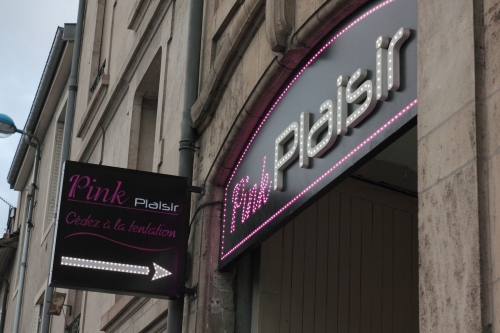
    Pink Plaisir. Vagues souvenirs sales, excitants, émouvants, comiques, grotesques, de débauche avec Florence. Ou de tractage dans les sex shop avec Sandra, Maxime, France.

    Rue de Saverne, en photographiant de vieilles maisons Art Nouveau, je me fais aborder par une gamine, la vingtaine, au look vaguement goth ou alternatif, qui me demande, tout-à-fait amicalement, avec un véritable intérêt, quelle est ma démarche.

    (Je réaliserai plus tard en refaisant mon trajet sur Google Street View qu'à l'angle du boulevard Lobau et de la rue de Saverne se trouve une vieille maison, rénovée, propre, mais qui il y a 25 ans était délabrée, avec un jardinet de hortensias morts, qui me fascinait, sous l'éclairage jaunâtre et glauque des réverbères, quand Pierre et moi errions dans ces parages)

    photos

    photos

    photos

    Je débouche avenue de Strasbourg, où je n'avais jamais mis les pieds, et avance au hasard, ne sachant pas où je suis, et heureux de ne pas savoir, jusqu'à achever mon errance devant l'église de Bonsecours. On finit toujours à l'église.

    ENGLISH

    2022-01-06 - Nancy (11).JPG

    Pink Plaisir. Dirty, exciting, moving, comical, grotesque fragments of debauchery with Florence. Or leafleting in sex shops with Sandra, Maxime, and France.

    On Rue de Saverne, while photographing old Art Nouveau houses, I’m approached by a girl – maybe in her twenties, vaguely goth or alternative in style – who, quite amicably and with genuine interest, asks me about my intentions.

    (I would later realize, retracing my steps on Google Street View, that at the corner of Boulevard Lobau and Rue de Saverne stands an old house – now renovated and clean – but 25 years ago it was run-down, with a small garden of dead hydrangeas that fascinated me under the sickly yellow glow of the streetlamps, when Pierre and I used to wander around that area)

    photos

    photos

    photos

    I emerge onto Avenue de Strasbourg, a place I had never set foot in before, and wander aimlessly, not knowing where I am – and glad not to know – until my wandering ends in front of the Church of Bonsecours. You always end up at a church.

    Lien permanent Catégories : Nancy, Photos 0 commentaire Pin it!
  • Souvenirs d'enfance vagues (non-daté) / Vague childhood memories (undated)

    FRANÇAIS

    Une entrée de garage mène à ce qui ressemble à un petit quartier caché. On ose à peine y entrer, pour découvrir des maisons basses et mitoyennes. Des plantes en pot sont disposées devant. Un vieux banc de bois. Un garage envahi par les herbes qui poussent à travers le sol craquelé, inégal. On s'attend à croiser le fantôme d'une grand-mère dont on aurait que des souvenirs d'enfance vagues. Derrière les façades des boulevards, les enseignes des franchises, les dorures et les ornements, c'est toujours la même tristesse ouvrière, les mêmes décors moroses et répétitifs qui se laissent explorer mais ne livrent rien de la vie qu'ils recèlent – ou ont recelée. Rue Keller, je m’arrête longuement devant un rosier qui a poussé le long d'un mur pourri et d'une fenêtre aux volets métalliques rouillés.

    ENGLISH

    A garage entrance leads to what looks like a hidden little neighborhood. One hardly dares to step inside, only to discover low, terraced houses. Potted plants are arranged out front. An old wooden bench. A garage overrun with weeds sprouting through the cracked, uneven ground. You half expect to run into the ghost of a grandmother you only remember vaguely from childhood. Behind the façades of the boulevards, behind the chain store signs, the gilding and ornaments, it’s always the same working-class sadness, the same dreary, repetitive settings – open to exploration, yet revealing nothing of the life they contain – or once contained. On Rue Keller, I stop for a long while in front of a rose bush that has grown along a rotting wall and a window with rusted metal shutters.

    Lien permanent Catégories : Explorations, Nancy 0 commentaire Pin it!
  • Limbes / Limbo

    FRANÇAIS

    J'ai commencé hier soir à scanner les négatifs de P. après avoir terminé les diapos. Impression désagréable, en voyant ces vieilles photos des rues de Nancy, ou de mon appartement ou de celui de P. constamment sous-exposées, ne montrant quasiment que des ombres, de retrouver l'ambiance de ces innombrables rêves où je suis seul dans mon studio, dans un ni-jour-ni-nuit où le temps ne passe pas, où il n'y a rien à faire, personne à voir ; des limbes.

    (ces limbes obscures où rien n'arrive jamais sont-elles une image, exagérée à fins pédagogiques par mon esprit, de mon existence ?)

    ENGLISH

    Last night I started scanning P.'s negatives after finishing the slides. I had the unpleasant impression, seeing these old photos of the streets of Nancy, or of my apartment, or of P.'s apartment, constantly underexposed, showing almost nothing but shadows, of rediscovering the atmosphere of those countless dreams in which I'm alone in my studio, in a ni-day-ni-night where time doesn't pass, where there's nothing to do, no one to see; limbo.

    (Is this dark limbo, where nothing ever happens, a pedagogically exaggerated image of my existence?)

    Lien permanent Catégories : Blog, Nancy 0 commentaire Pin it!
  • Memories of the Grey City

    "I'm publishing here, in full, the article that appeared on Pays Fantôme.

    "The Grey City first appeared to me in dreams; dreams spaced far apart over a long period of years; then I learned to recognise it elsewhere, in films, video games, and in the streets of the towns and villages I visited in my daytime life. I drew some conclusions.

    You can't map the Grey City.

    You can't locate it.

    It exists discontinuously in an unknown number of real cities, night dreams or fictions.

    All it takes is for the light to change at the turn of a street, a shade of colour on a building, and I know I have just entered the Grey City. Whether I am awake or dreaming. And I realise that I had forgotten it once again, and that this rediscovery, this anamnesis, is just one more; that there have been a number of others that I am unable to remember.

    This awareness of forgetting and remembering is an integral part of how one experiences the Grey City."

    *

    A few months ago, Pays Fantôme received an e-mail from an anonymous person claiming to have been a member of a certain Groupement Psychogéographique de l'Est (Eastern Psychogeographical Group), who wished to send us an audio cassette containing about 17 minutes of music and various documents such as screen shots of a game on the Amstrad CPC 6128 or all sorts of texts, illustrated or not: dream stories, fictions, essays, material for role-playing games, etc.

    After receiving and examining the material sent to us, it became clear that we had to republish all this, at least in part. Of course, there is no proof that this is not a hoax, but it does not matter whether the Groupement Psychogéographique de l'Est really existed or whether this anonymous correspondent tired of inventing the evidence for an affair that never took place. In any case, it is by no means impossible that it existed. But if it didn't, the sheer effort to make it seem so is enough to make it more than a fake: a work of fiction in its own right.

    We sent a number of questions to this anonymous person, and we offer here a synthesis of his or her answers. They are an integral part of the work, in our opinion.

    The documents that accompany the release are provided with it when you download it on Bandcamp, or can be consulted online at Archive.org.

    *

    All the paragraphs below are extracts from our email exchanges with the GPE representative.

    *

    "The name Groupement Psychogéographique de l'Est is almost a joke. We were a few friends from all over Champagne and Alsace, passing through Meurthe-et-Moselle and Meuse, and we attended the same campus (Lettres Sciences Humaines). One of us had somehow stumbled upon Debord's texts and various articles on psychogeography in the university library – there was obviously no Internet, and no Google of course, in France at the time, and discovering this kind of marginal hobby was a bit more hazardous.

    We appropriated the term, putting it to our own use and stripping it of all the politicised aspect it originally had, but of which we were hardly aware anyway. We were clearly not interested in analysing, challenging or reforming society by studying the environments in which we lived.

    We were already big walkers and big fans of urban exploration (not at all in the sense that urbex is understood today; we didn't go into abandoned factories or anything like that) and rural exploration. To put it in less snobbish terms, we liked to wander, to wander, to be surprised by the landscape, whether it was the city landscape or not.

    The discovery of psychogeography theorised by Guy Debord simply gave us even more ideas, ideas to extend our experiences. In an intimate, playful and aesthetic way."

    *

    "The name Groupement Psychogéographique de l'Est thus became the one under which we published, at first (in the form of small typewritten, handwritten booklets, or printed at the university when we had the possibility), accounts of walks, sometimes embellished with photos, and more general texts on the question of places in our lives, of their weight in the imaginary, in individual and collective psychic life, etc.

    It sounds very theoretical and pompous and theoretical when you put it like that, but once again it was a visceral and intimate approach, for all of us.

    There were no rules and no set methods. Each member of the group – there were about ten or a dozen in all, over the few years that it lasted – was perfectly free to define his or her own field of research or methods.

    [...]

    Some of them essentially took photographs during their explorations. And did not produce a written commentary or something very short. The photographs spoke for themselves. They were designed to capture not only the atmosphere of a place, its specificity, and the effect it had on the artist, but to reveal what was secret about it, invisible, perhaps, to those who approached it in their daily lives with a purely utilitarian eye.

    Other members left with a dictaphone on which they recorded all their thoughts, their emotions, all the micro-events of their walk. They would then write either a synthesis or a complete, literal transcription of their recording.

    Some planned their exploration exactly, using a map. Others (like me) would drive off at random, sometimes not even knowing which town they were going to stop in. They waited to see something, or to feel an inner signal that they should stop here or there.

    Between the exhaustive exploration of a place and the hazardous dérive (drift), content with a single journey through a city, missing most of it, everything was possible. Even explorations limited to night-time dreams... And even fictional explorations, not just from the writer's imagination, but from meditation and daydreaming. Or exploring a city through photographs of its streets.

    I can imagine what we could have done at the time if Google Street View had existed."

    *

    "Personally, as I said, I used to do a lot of driving alone. I had just lost my mother, when I was twenty, and I had inherited her Ford. For a long time I had a very strong need for solitude. I spent at least a year of my life taking, as often as possible, a whole day or a night, without telling anyone, to wander around the region in my car, driving randomly for dozens or sometimes hundreds of kilometres. I took pictures in the towns and villages where I stopped, or sometimes just through the windscreen."
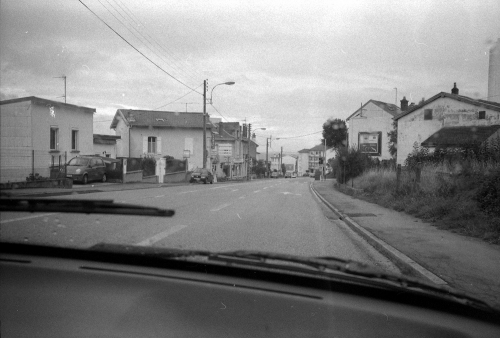
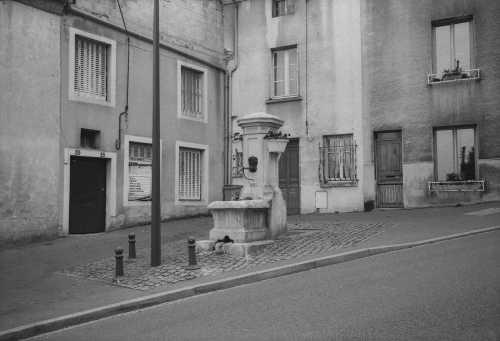
    img667-2.jpg

    img636-3.jpg

    "The name Souvenirs de la Ville Grise (Memories of the Grey City) also comes from the fact that I took a lot of black and white photos at the time. I developed and printed them myself, at a friend's house who had the necessary equipment. A number of prints were considered to be part of the Group's official inventory afterwards. I sold some of them, mostly to acquaintances and friends, to be honest. Two or three were reproduced in local fanzines at the time."
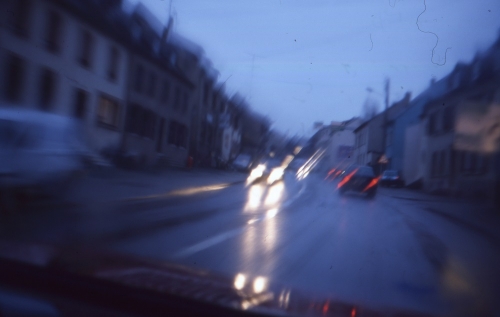
    img336-2.jpg

    "There is something indefinable but very intense for me in the fact of being alone at the wheel, in an unknown city, at nightfall or in the early hours of the morning; a city where I have nothing to do, no one to see, where no one knows that I am. With the windscreen as a screen, that is to say, both as protection and as a medium (like a cinema screen) that allows me to have an experience of the world that is not direct but aesthetic above all. It is a type of mental state that I discovered by chance and that I voluntarily sought out afterwards. The others have had the same kind of evolution; first pure experience, then you theorise, you systematise."

    *

    "I no longer have the originals of our brochures but that doesn't matter much, at the time we used an Atari to archive all our texts with Writer software, and as it saved files in .doc format I still have all our writings. Maybe it will be republished one day in some way, I don't have any definite plans for it at the moment. Not on paper, I think, there's no audience for that, but today any blog or Archive.org account allows you to reach out to the whole world."

    atari1.jpg

    atari2.jpg

    *

    "We lived mainly in medium-sized cities or small towns. Our explorations were essentially in these types of environments, including villages. With very large cities like Paris or Lyon we have almost only had imaginary relationships, through books, cinema, etc. The Parisian drift interests me moderately.

    I'm not very interested in the Parisian dérive (drift). I had the opportunity to practice it, in an involuntary way, since I lived in Paris for a few weeks and during my free time (I was working in a small supermarket on Place Léon Blum and had my afternoons free) I wandered around the neighbourhoods around mine, discovering for example the Jardin Naturel and a few streets that were not very interesting but that attracted me for this precise reason, near Père Lachaise. An interesting experience, but Paris was still too big, too crowded, too hostile for a provincial like me. 

    [...]

    As a young student, I loved the film Death in Venice, for example, and this city (which also appears in a video game I liked as a teenager, called Masque) obsessed me for some time. I would dream about it at night, dream that I was exploring it and getting happily lost in it."

    Masque036.jpg

    "Even though I know it's beautiful and I'm probably missing something, I don't want to see the real Venice. Just as I'm content with the Lyon that you can see in Bertrand Tavernier's L'horloger de Saint-Paul."

    *

    "Our region has a strong industrial past, mining, steelmaking, etc. Many of our cities are very marked architecturally by the boom of the 19th century but also by the decline of the last few decades. The Grey City is also a city grey with pollution, grey with grime, which the captains of industry left us after abandoning us. But again, even if it was part of our imagination, we were not interested in denouncing this situation. On the other hand, we were aware that living in this kind of environment produced a state of mind, even particular states of consciousness."

    *

    "We were big fans of video games and role-playing games. When I say video games, you have to remember that this was the late 80s/early and mid 90s. Most of us had a microcomputer culture and not a PC or console culture. I played a lot, as a teenager, when they came out, Lankhor's adventure games, for example: Le Manoir de Mortevielle, La Secte Noire... some American games, too, that were never translated, like Zork. I already mentioned Masque, too."

    *

    "Several of us were involved in a municipal computer club. It was still the great era of the Atari and the Amiga."

    *

    "Our playing of video games also influenced the way we approached the world and the real places we explored. Exploring the real had become a kind of game in itself, an extension of what we were experiencing in the video games – and vice versa."

    *

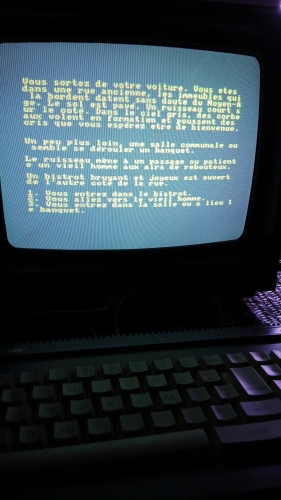
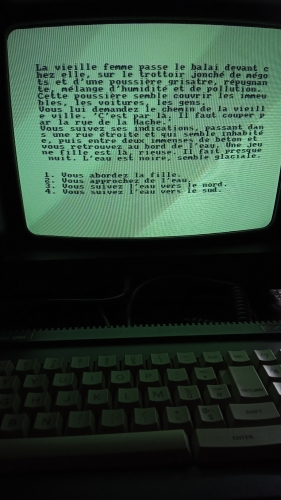
    "One of us had written a small program in Basic for Amstrad CPC. At the beginning of the 90's, this machine was becoming obsolete but was still very widespread and had its fanatics (who still exist, by the way). It was a kind of interactive, text-based walkthrough, but with some illustrations, in an imaginary city inspired by several of our explorations. It worked with multiple choices, like a Choose Your Own Adventure Book."

    IMG_20230216_105652.jpg

    IMG_20230216_105716.jpg

    IMG_20230216_105823_1.jpg

    "It was a relatively chaotic game, with a storyline of bits and pieces, which tried to exploit as much as possible our notes taken during wanderings, or from our reflections, etc. It was sewn with white thread and in the end the game has a dreamlike, slightly surreal and bizarre side, sometimes a little sinister too, I must admit. There weren't really any puzzles, objects to manipulate, or NPCs to interact with, because the programmer was incapable of doing that sort of thing; in the end you just wander from place to place and see what happens. A bit like ourselves in our real lives at the time...

    This game also had no title. It was shared with the few members who were interested, and that was it. I have it on floppy disk but a few years ago I took the time to copy all the code."

    *

    "Some of us were doing some music, or at least had keyboards and synths, and started working together. This resulted in a tape, which was untitled by the way. It wasn't really a demo, even though it was called a demo; it was just a collection of songs recorded one after the other over the weeks and months that we had no intention of ever reworking and offering to a record company.

    The version I'm sending you is just a small, incomplete and damaged edit (a few seconds of music are missing here and there) of tracks we recorded at the time.

    The main influence, I would say, was Désaccord Majeur – and to a lesser extent État des Stocks. Désaccord Majeur is a French project that has been around since the late 80s and is a kind of French answer to Zoviet France or Rapoon; basically, post-industrial music with a strong ethnic slant. Personally I was an absolute fan of the tape Le Point immobile vibrant.

    It was also a label. For example, they released the first demo of Moments Présents, which we liked a lot but which was much darker. We wanted to keep a certain lightness.

    *

    "As for État des Stocks, it is a Belgian project, electronic and experimental, more abstract. But these two projects had a side that was both very realistic, through the use of samples from the television news or historical audio documents, and very surreal, timeless, unclassifiable, through their mixtures, their collages of sounds from very different sources.

    The mental effect produced by the passage from one atmosphere to another, in a city in particular, is one of the pillars of psychogeography. One can therefore almost speak of sonic psychogeography, concerning them."

    *

    "As for the instruments, we used exclusively analogue synthesizers and keyboards such as the PSS 390 which uses FM synthesis. The songs were recorded directly onto tape. We didn't even have a 4-track; we used the family hi-fi system with its line-in as a tape recorder. The samples were played at the same time, from another tape player where we had recorded them beforehand.

    The tracks are quite repetitive, by design. Most of them are totally improvised. We would play together, each with his own synth, and when one of us would find a pattern and repeat it, another would follow and play the same musical phrase over and over again, and so on. This avoided making too many wrong notes or getting into cross solos that wouldn't work. We were not great musicians and we were well aware of that.

    But we liked minimalist and repetitive music anyway, for its hypnotic, meditative, dreamy qualities. I listened to the tape quite a lot, on my bed, alone, in the dark, or trying to put myself in a state between waking and sleeping, and visualizing things; places, people, scenes. Our songs had this slightly utilitarian feel to them, like music on a new-age relationship tape can have."

    *

    "We sampled, among other things, the TV news and reports that were on at the time. The old working-class Paris, the France of yesteryear, the dirty, grey, dilapidated streets, the near-taudis that still constituted, only 40 or 50 years ago, the reality of working-class Paris. I could have loved that Paris. Nowadays you can find it very easily on the INA website and it's a real relief to be able to go back to it."

    Screen Shot 549.JPG

    Screen Shot 557.JPG

    Screen Shot 558.JPG

    Screen Shot 562.JPG

    "Archival videos today allow us to immerse ourselves in this magnificent greyness, in these old working-class neighbourhoods of Paris or the provinces, whose ugliness and misery, dilapidation and dilapidation, seem today to be miraculous, precious, desirable – I can't say exactly why. Perhaps simply out of nostalgia. Perhaps also because they bear the patina of time and reality, when our cities are more and more non-places, staged scenes, empty amusement park sets. In any case, there was something about these old, grey and sad neighbourhoods that obsessed us.

    In terms of samples there are a few seconds of sampled screams from the film Themroc, too. And the screams of a woman who was probably on the verge of mental illness, yelling at whoever it was, which one of us had recorded discreetly with a tape recorder in the street. It was something we did often. I kept this habit, without trying to find a use for it.

    On the penultimate track, I think, there is the voice of a man praying in Hebrew; a Parisian Jew, in a random TV report from a few decades ago. There was no spiritual component whatsoever in the productions of the Groupement Psychogéographique de l'Est, but as a purely atmospheric element we liked anything that sounded even vaguely esoteric and mysterious."

    *

    "The reception of the tape was almost nil, which is normal since we only released it privately. No reviews and almost no distribution, except in two or three record shops that agreed to sell demos, such as Ombre Sonore in Strasbourg, or the bookshop La Parenthèse, in Nancy. WAVE, on the other hand, sent us packing. A local radio station broadcast a song during a programme devoted to the Eastern scene. That's about it. I remember that the tape was priced exceptionally low because it was so short and very amateurish, very messy.

    In total, I would say that about twenty or thirty copies were put into circulation; most of them were given to friends. We had copied fifty, in advance, thinking that would be enough, and in the end we didn't manage to sell them."

    img447.jpg

    "This is the only tape recorded by the Groupement Psychogéographique de l'Est as such, but I know that at least two members have released other demos in a rather similar vein, or a bit more influenced by the Middle Ages, role-playing games, symbolism, that sort of thing..."

    *

    "The Group lasted four or five years. The time of our studies...

    We were not active, or let's say, productive, all the time. As I said, it was almost a joke, a role-playing game in itself: playing the little avant-garde group. It's always been a specifically French game, it seems to me. But it seems to have been lost over the years.

    As for me, I have lost contact with most of the members of the Group, but I have kept a solid friendship with some of them. Having said that, we no longer have any activities in common, and even less that are linked to psychogeography, which cannot be said to have made many fans in France, unlike in the United Kingdom for example.

    No one, to my knowledge, has broken through or sought to break through in the world of music or art. Many have gone into teaching or the civil service.

    I continue to wander around, like everyone else, in the end, and I report my discoveries in a little diary that serves no other purpose, but that's as far as my approach goes."

    *

    "I am not at all interested in the current revival in Anglo-Saxon countries for psychogeography. Or to be exact I stopped being interested after doing some research in this field. It's far too politicised on the one hand, and from the little I've seen, on the other hand, it's stuck with the old techniques like drifting, all that kind of cliché. Once again, I'm not interested in exploring with the aim, admitted or not, of passing judgement on society. Whether the world is beautiful or ugly, whether it is fair or not, whether it is a paradise or a prison, interests me as a citizen but not as a walker, not as a dreamer.

    As for the fashion for rural psychogeography, as with the fanzine Weird Walks, I find it all too marked by a rather grotesque neo-paganism and the search for a land of plenty to reconnect with when the interesting reality to explore is rather that of the death of the countryside; deserted villages, the destruction of ancient communities and traditional ways of life, inhuman agriculture, etc."

    *

    "The new visual proposed today with the demo is a painting showing a commedia dell'arte scene; it did not exist at the time, but I always wanted to use this kind of imagery one day. This painting has the advantage of showing a rather heavy sky; it remains in the theme of grisaille. I have been told that this picture could be read as a saucy image; I must confess that I did not realise it at first...".
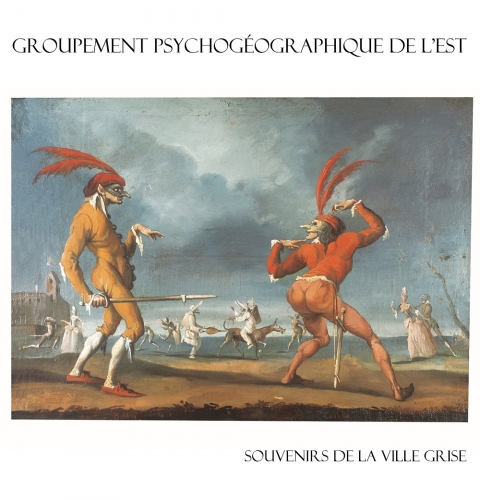
    Groupement Psychog_ographique de l'Est - Souvenirs de la Ville Grise.jpg

    "This sky also makes me think of the northern sky, of course; of my youthful trips to Bruges or Ostend. Of the Bal du Rat Mort (Dead Rat Ball). Of authors like Ghelderode...

    I love masks and carnival. I still have a vivid memory of a nightmare I had as a teenager when I was wandering around an old town with narrow, winding streets and came across a kind of Pierrot with his throat cut, sitting on the cobblestones with his back against a wall. This kind of aesthetic is for me inseparable from the imaginary of the city in general.

    There are several cities that have left their mark on my imagination over the decades, and it seems to me that they form only one, although they undeniably take on masks to appear to me – in the waking state, or in my dreams at night. That's why the record is now called Memories of the Grey City, and not of the Grey Cities."

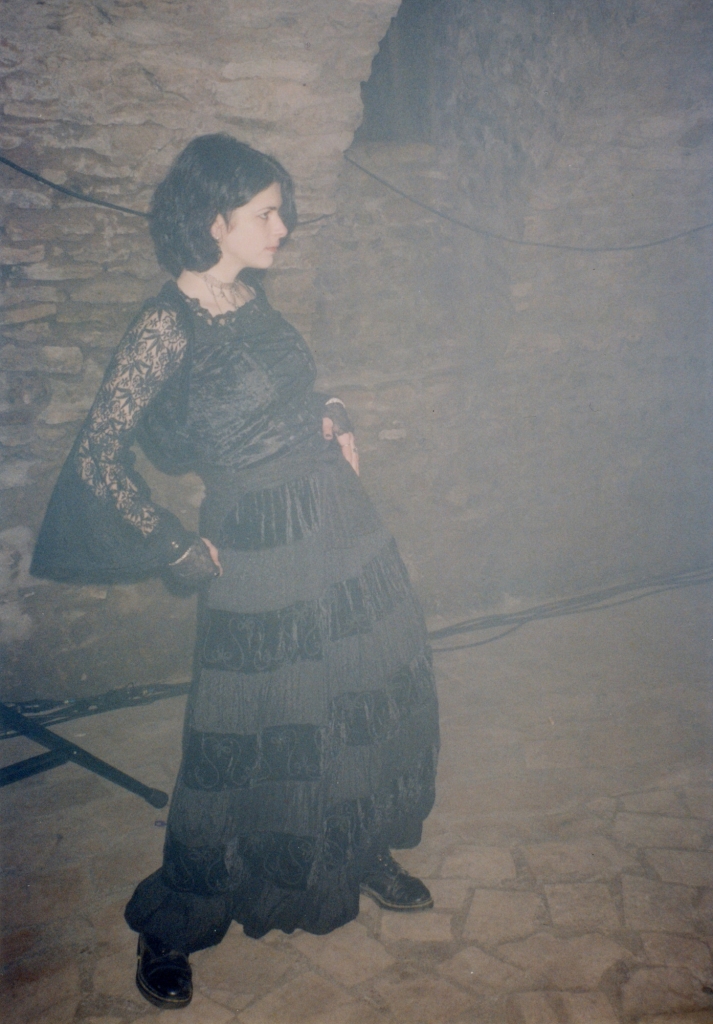
    Lien permanent Catégories : Liens / Links, Musique / Music, Nancy 0 commentaire Pin it!